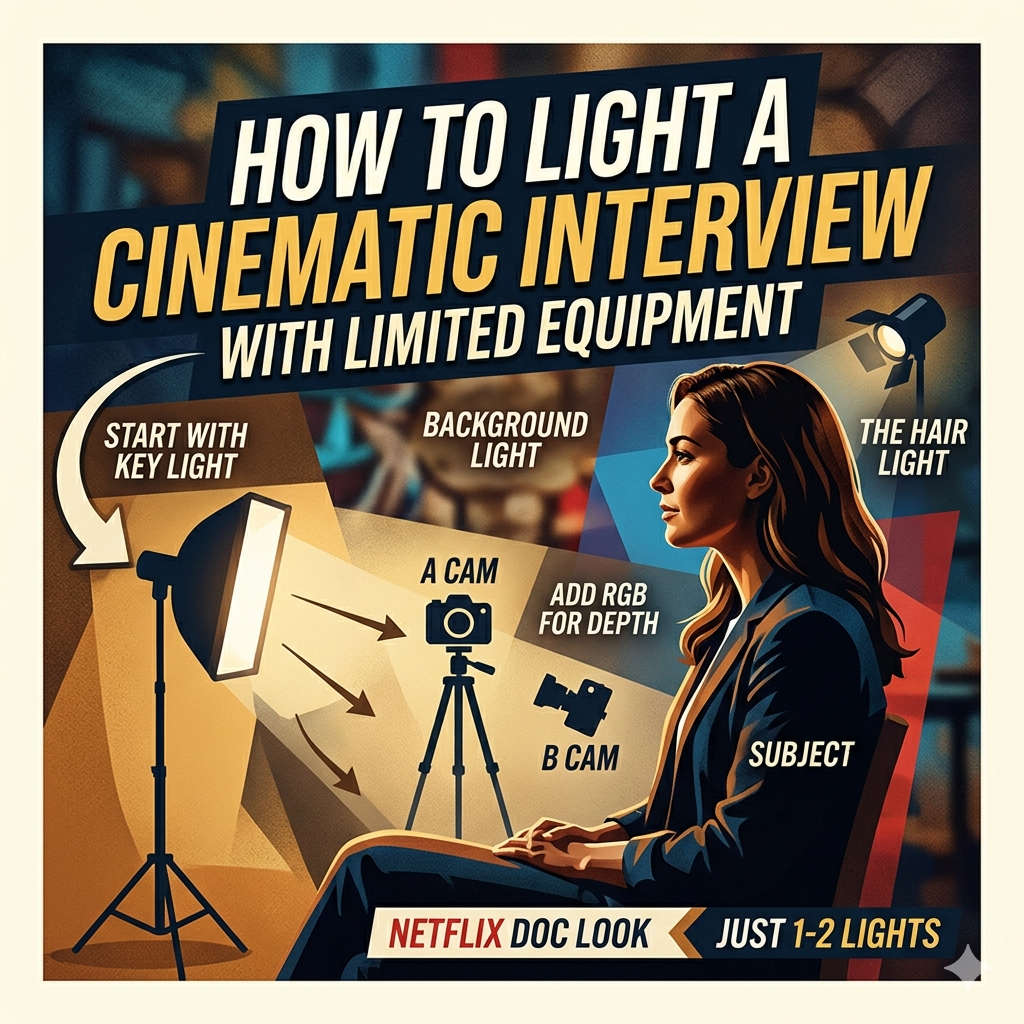
- Start with your key light
Everything starts here. Your key light is your main source, and it should be placed slightly off to one side of your subject. Not directly in front of them, but not fully to the side either. That slight angle is what creates dimension and makes the shot feel cinematic instead of flat. If you only have one light, this is the one. A single key light alone can look surprisingly good if it's placed right.
-
Camera placement matters just as much
Once your key is set, I put my A camera straight in front of the subject, and then my B camera goes on the opposite side from the key light. That angle from the B cam naturally catches more shadow and dimension, which gives you a totally different look to cut between. Also, position your camera as far back as possible. The farther back you are, the better your focal length and aperture can work together to compress the background and get that shallow depth of field that makes everything look high-end.
-
Add light to your background
A backlit backdrop makes a massive difference. Even a cheap light pointed at the wall behind your subject adds depth and separates them from the background. I also like throwing some RGB lights behind the subject to add a color element. Even a subtle color cast back there can take an interview from looking like a YouTube video to looking like a Netflix doc.
-
The hair light
If you want to take it a step further, add a hair light. This one goes on the opposite side from your B camera, positioned slightly above and behind your subject. It creates a rim of light on their hair and shoulders that separates them from the background and adds a really clean cinematic feel. It's one of those details that people might not notice consciously, but they'll feel it. Make the whole thing cinematic, not just the light.
The background you choose matters. Think about what's in frame. A boring white wall is going to look boring regardless of how good your lighting is. Put something interesting back there, or at least add some depth with distance and light. And ask cinematic questions. The way someone responds changes completely when you're asking them something that actually draws something out of them instead of a surface-level answer. The whole frame, the light, the location, and the conversation all work together. You don't need a big budget. You just need to understand what each light is doing and why.